
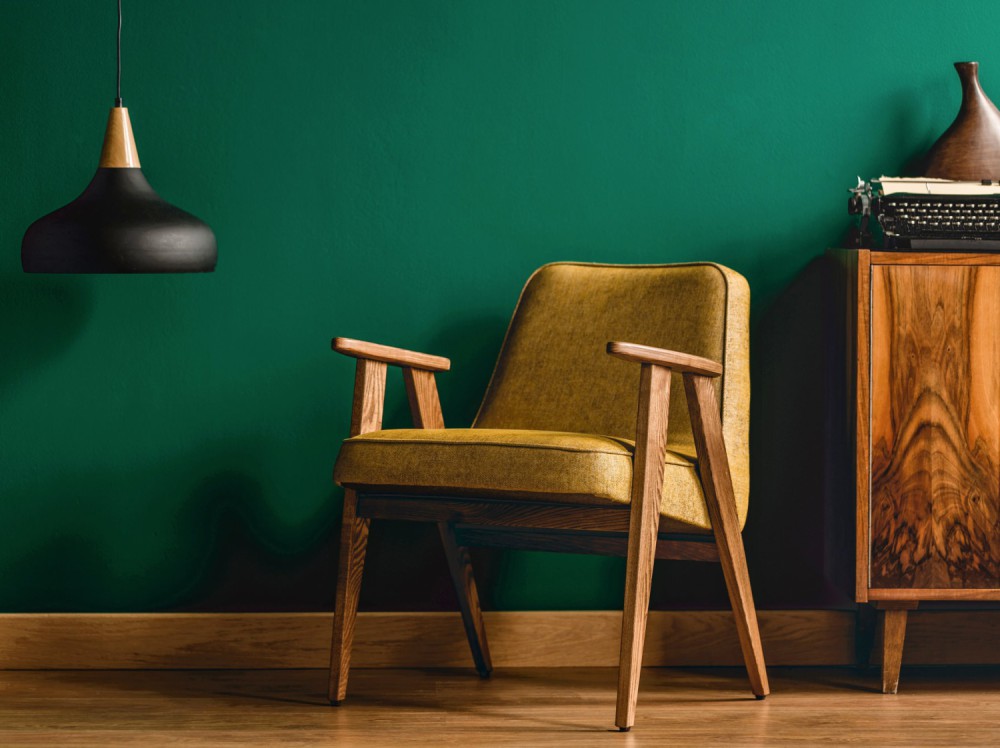
Whether you own a contemporary-style home or love hunting for one-of-a-kind treasures, you can blend objects from the past with a today’s decor styles in countless ways.
When carefully selected and arranged, antiques lend a touch of richness, warmth, and authenticity to our interiors… without making them feel like a cluttered attic!
As an extra bonus, this trend aligns perfectly with today’s environmental concerns.
Create a Focal Point
The first rule is simple: pick one statement piece and let it take centre stage.
- A tall antique grandfather clock
- A farmhouse sideboard
- An old dressing table
- A chest of drawers from the 1940s
- A church bench
- A vintage sewing machine
- A hutch from the 1920s
- Etc.
The idea is to make this piece the focal point of the modern room.
Place it in an open space with lighting that shows it off to its best advantage and avoid crowding it with other heavy pieces. The aim is to create a bold contrast: a single antique piece of furniture, in a minimalist setting, speaks for itself.
Restore Without Altering the Piece’s Character
Before introducing a salvaged item into your decor, take the time to recondition it without erasing its history. Returning it to its true original condition might strip it of all its character.
For example:
- Lightly sand a piece of furniture to remove dirt but take care to leave the patina.
- Only replace actually damaged parts: a broken handle, a rusty hinge, a stuck drawer.
- Antique textiles, such as an old rug or a hand-woven blanket, should be professionally cleaned. This will extend their life by several years, while avoiding allergies and dust.
- Touch up with paint, if necessary, using the exact shade or a popular colour from the period.
Follow the Rule of 3 for Materials
One useful tip is to apply the rule of three for materials in a room. Restrict yourself, for example, to wood, metal and fabric. This preserves the decor’s visual balance and prevents an antique piece from looking out of place in the room.
If your living room features metal, glass, and smooth surfaces, a piece of raw wood furniture or a weathered chest will add warmth and depth. Conversely, in a home that is already full of cozy elements, a reclaimed stone or aged metal object will provide contrast.
Have Old Things Serve a Real Function
Transforming thrifted items into useful objects is the best way to keep the overall effect from feeling forced:
- An old milk crate can serve as a storage basket for blankets in the living room.
- A vintage suitcase can be turned into a side table.
- A salvaged door, reinforced and varnished, can be repurposed into an original headboard.
Subtly Create Thematic Zones
If you have several antiques, scatter them throughout your home rather than arranging them all together in a single space. A collection of small treasures is best appreciated when displayed individually in various rooms of the house. This creates a subtle unifying theme without overloading any one area.
For example, place an old mirror in the hallway, an industrial lamp in the office, and a rustic bench in the dining room—don’t pile all these pieces in the living room.
Set the Scene With Lighting
There’s nothing like the right lighting to make an antique piece shine. Lighting can highlight unique details while giving the whole space a contemporary look.
You can, for instance, place a picture light above an antique painting or install an LED strip under a shelf on which a vintage object is displayed.
Boldy Embrace the Mix of Styles
Achieving a cohesive decor doesn’t mean everything has to look the same. On the contrary: choose a colour scheme that allows the modern and historic elements to play off each other. For example, if you have an old piece of gilded wood furniture, pair it with a few brass or ochre-hued accessories in the room. This visual link will be enough to bring the styles together.
In short, integrating antiques into your modern decor lets every room in your home tell a story!